
An Analysis of Litbuy Spreadsheet’s Efficient Price Comparison Method
Explore curated product lists with Litbuy Spreadsheet to make online shopping more efficient, cost-effective, and smart.
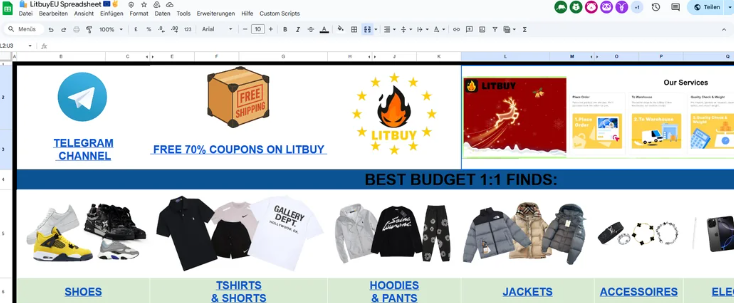
Litbuy Spreadsheet Efficient Price Comparison Methods Explained: A Complete SEO Guide
In the era of global e-commerce, one of the biggest challenges for online shoppers and resellers is finding the best price without wasting time. Prices vary across platforms, suppliers, and regions, making manual comparison inefficient and often inaccurate.
The Litbuy Spreadsheet solves this problem by turning scattered product data into a structured system that enables fast, accurate, and data-driven price comparison. This article explains the most effective methods to use Litbuy Spreadsheet for high-efficiency price comparison and smarter purchasing decisions.
What Is Litbuy Spreadsheet?
The Litbuy Spreadsheet is a structured digital tool that organizes global product listings into a centralized spreadsheet format. It typically includes:
Product names and categories
Supplier sources
Multiple pricing entries
Shipping information
Product notes and recommendations
Its core function is to make price comparison fast, transparent, and systematic.
Why Efficient Price Comparison Matters
In global shopping, prices are rarely consistent because of:
Different suppliers offering varying rates
Regional pricing strategies
Shipping and handling differences
Temporary promotions or discounts
Without structured comparison, users often:
Overpay for products
Miss better deals
Waste time switching between platforms
Litbuy Spreadsheet eliminates these inefficiencies.
Method 1: Side-by-Side Price Comparison
The most fundamental method is direct comparison across listings.
In the spreadsheet, a single product may appear multiple times from different suppliers. Users should:
Compare at least 3 listings per product
Identify the lowest and highest price range
Check consistency across suppliers
This method quickly reveals real market pricing differences.
Method 2: Analyze Price Range Distribution
Instead of focusing on one number, users should evaluate the full price range.
For example:
Low-end supplier price
Average market price
Premium supplier price
This helps identify whether a deal is truly cheap or just appears so on the surface.
Method 3: Compare Total Cost (Not Just Product Price)
A common mistake in e-commerce is ignoring hidden costs.
Effective comparison includes:
Product base price
Shipping fees
Handling or service charges
Delivery speed impact
A slightly higher product price may still be cheaper overall if shipping is lower.
Method 4: Identify Price Outliers
Outliers often reveal hidden opportunities.
Look for:
Significantly lower-priced listings
Unexpected high-price duplicates
Supplier-specific anomalies
Outliers can indicate:
Discounted stock
New supplier entry
Temporary promotions
These are key opportunities for savings.
Method 5: Compare Across Categories and Variants
Some products appear in multiple variations:
Different colors
Material differences
Packaging options
Bundle vs single item listings
Comparing variants helps ensure you are not paying more for unnecessary differences.
Method 6: Track Price Changes Over Time
Advanced users don’t rely on a single snapshot.
Instead, they:
Monitor pricing updates regularly
Track seasonal fluctuations
Identify recurring discount cycles
Compare historical price trends
This helps determine the best time to buy.
Method 7: Evaluate Supplier-Based Pricing Differences
Suppliers play a major role in pricing variation.
Users should compare:
Trusted vs new suppliers
Bulk vs retail pricing structures
Regional supplier differences
This often reveals why identical products have different price tags.
Method 8: Use Filtering for Faster Comparison
Filtering is essential for efficiency.
Recommended filters include:
Price range
Product category
Supplier type
Popularity or trend status
Filtering reduces noise and makes price comparison more precise.
Method 9: Benchmark Against Market Average
Instead of comparing only listings inside the spreadsheet, users should:
Estimate average market price
Compare spreadsheet listings to that benchmark
Identify undervalued or overpriced items
This ensures decisions are aligned with real market value.
Common Mistakes in Price Comparison
Avoid these errors:
❌ Focusing only on the lowest price
❌ Ignoring shipping costs
❌ Not comparing enough suppliers
❌ Overlooking product variants
❌ Making impulse decisions
These mistakes reduce the effectiveness of any comparison strategy.
Why Litbuy Spreadsheet Outperforms Manual Comparison
Traditional price comparison methods rely on:
Manual browsing
Switching between websites
Inconsistent data sources
This leads to inefficiency and missed opportunities.
Litbuy Spreadsheet improves the process by:
Centralizing global pricing data
Standardizing product listings
Enabling instant multi-supplier comparison
Reducing decision time significantly
Who Benefits Most from These Methods?
These strategies are ideal for:
Online shoppers looking for savings
Dropshipping entrepreneurs
E-commerce store owners
Product researchers
Global deal hunters
Anyone who values cost efficiency and fast decision-making can benefit.
Final Thoughts
The Litbuy Spreadsheet high-efficiency price comparison method transforms how users evaluate products in global e-commerce. By combining structured data, multi-supplier visibility, and systematic comparison strategies, it eliminates guesswork and improves purchasing accuracy.
Instead of manually searching across platforms, users can make faster, smarter, and more cost-effective decisions using a structured workflow.
In today’s competitive online marketplace, mastering these comparison techniques is not just useful—it is a strategic advantage for smarter global shopping.
litbuy
Connecting users with factories for seamless shopping.
Secure
Quality
contact@cnfansfindsheet.com
13859788884
© 2025. All rights reserved.